

The Agent-led Growth Framework
Something is changing in how things get found and bought.

Something is changing in how things get found and bought. Increasingly, the first thing looking at your product is not a person. It is an agent searching, comparing, choosing, and eventually paying.
Automated traffic passed human traffic on the web for the first time, at 51% in 2024, and is already over 53% in 20261. Google referrals are down 19.9% since 2024, while referrals from ChatGPT, Claude, Gemini and other AI platforms are surging2. And it goes beyond discovery, in June 2026, Supabase said more than 60% of new databases on its platform were created by AI coding tools.
That changes how businesses should approach growth, as it moves from human centric to agent centric. This piece is my attempt at a framework for Agent-led Growth, what it is, where it applies, and how to use it to grow.
The name comes from Product-led Growth. PLG made the product itself responsible for acquisition, conversion and expansion. Agent-led Growth asks a different question.
What changes when agents start doing more of the discovering, evaluating, using and buying?
Agent-led Growth has the potential to be more impactful than PLG or any other growth model for one reason. Scope. PLG worked for software you could sign up for and use yourself. Agents reach much further. Products, services, brands, people.
How Agent-led Growth is Defined Today
Neal Behrend at Insight Partners splits Agent-led Growth into two sides3. Supply-side ALG is companies using agents to sell more efficiently. Demand-side ALG is agents working for buyers, researching, comparing and eventually recommending or purchasing.
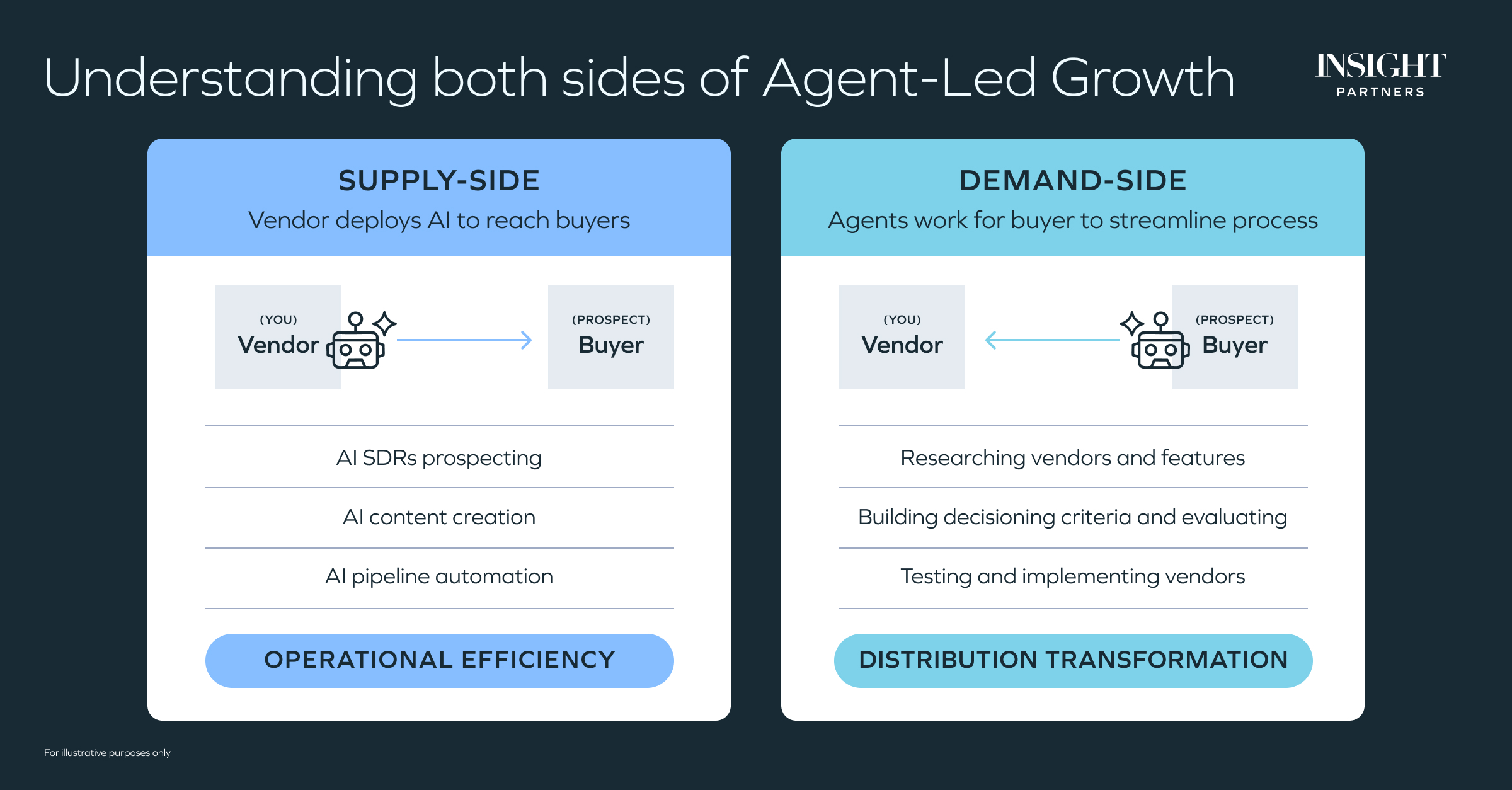
I agree with that split, but I think the demand-side shift starts earlier than go-to-market. By the time you are rewriting documentation or optimizing for discovery, the important decisions have already been made. Whether the product has an API, whether pricing works without seats, whether what you publish can be read by machines.
Agent-led Growth starts at product design and engineering, changes how you market, and how you get paid.
The Agent-led Growth Framework
Agent-led Growth has two engines. One is how you build for agents. The other is how you use agents to grow.
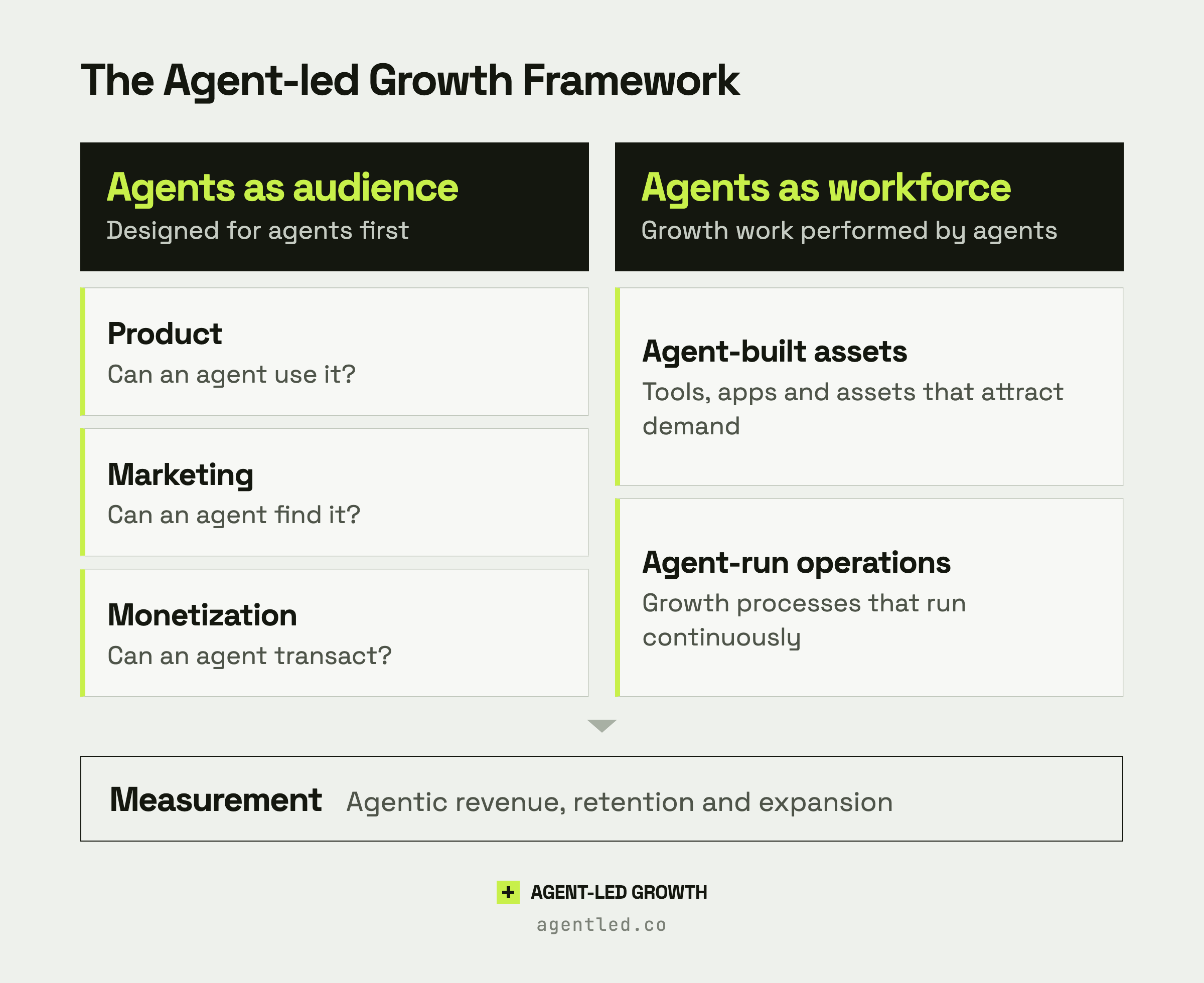
Agents as Audience
If agents are part of the audience, three things matter. Can they use what you offer, find it, and transact with it?
1. Product: Can an agent use it?
If an agent cannot reach, understand or operate what you offer, nothing downstream matters.
API-first: If your product only exists behind a UI, an agent has to navigate an interface built for humans. A clean API gives it a direct path.
Documentation is the interface: Agents read docs to understand what a product does and how to use it. Anything important that only exists in a sales call is missing.
Open source, where it fits: Open code creates more surface area for agents to learn from: repositories, examples, templates and implementations.
Efficiency: Agents spend tokens and time. Every extra decision, ambiguous default or setup step adds cost and another place to fail. Token-to-value is the machine version of time-to-value, measuring how quickly an agent can understand that you solve the problem and put you to work.
Reliability: A human may tolerate friction because switching takes effort. An agent can simply choose something else on the next run.
If this sounds like developer-tool advice, it is. Good APIs, good docs, clear defaults and low friction were already standard there. Now other categories have to follow the same logic.
If you are wondering how that translates to other categories, it isn’t too complicated. For a service business, the equivalent is public pricing, location, structured service descriptions, visible availability, and a clear way to take the first step (booking, making a reservation, etc.).
2. Marketing: Can an agent find it?
Once an agent can use what you offer, the next question is whether it can find you.
Structure beats style: Direct answers, clear facts and structured content are easier for models to retrieve and ground on. In practice, that means machine-readable pages, pages that the crawlers you want can access, and knowledge packaged in formats agents can use.
Place matters as much as structure: Models rely more heavily on some sources than others (Reddit, LinkedIn, YouTube, Quora, etc). Those preferences change across vendors and over time, so distribution has to be measured rather than assumed.
AEO is downstream: Getting cited and recommended by AI assistants is key, but it is the result of the product and distribution decisions that come before it, not the whole strategy.
Agents also make previously slow or expensive marketing tactics viable. We’ll cover those under Agents as Workforce.
3. Monetization: can an agent transact?
The final question is whether an agent can move from choosing a product to paying for it. This is also where some of the biggest disruption is happening. Pricing, identity and payments are all being reworked for a world where agents can transact on their own.
Seats stop making sense: Per-seat pricing assumes headcount tracks usage. Agents are one and all, meaning, they only need one seat.
Price the unit that tracks value: API calls, transactions, tasks completed, records processed: charge against the thing that grows as the customer gets more value.
Usage-based pricing fits some agentic products better: Per-call or usage-based pricing fits agent behavior better than a fixed monthly plan.
Free tiers remove friction: An agent can try something without needing a human to approve a purchase first.
The bigger gap is payments. An agent can discover and choose a product but still needs a human to create an account, add a payment method or generate a key. Cloudflare Wallets4 point toward a different model. The agent gets a wallet with spending limits and a readable identity, removing the handoff back to a human.
As identity and payments mature, more purchases can move from human-assisted handoffs to transactions agents complete themselves. For now, keep pricing public, signup self-serve, and the path to payment as short as possible.
Agents as Workforce
The other side of the framework is using agents to do growth work.
Speed alone is not the point. Everyone is faster now. What matters is that previously expensive or operationally heavy tactics are becoming viable.
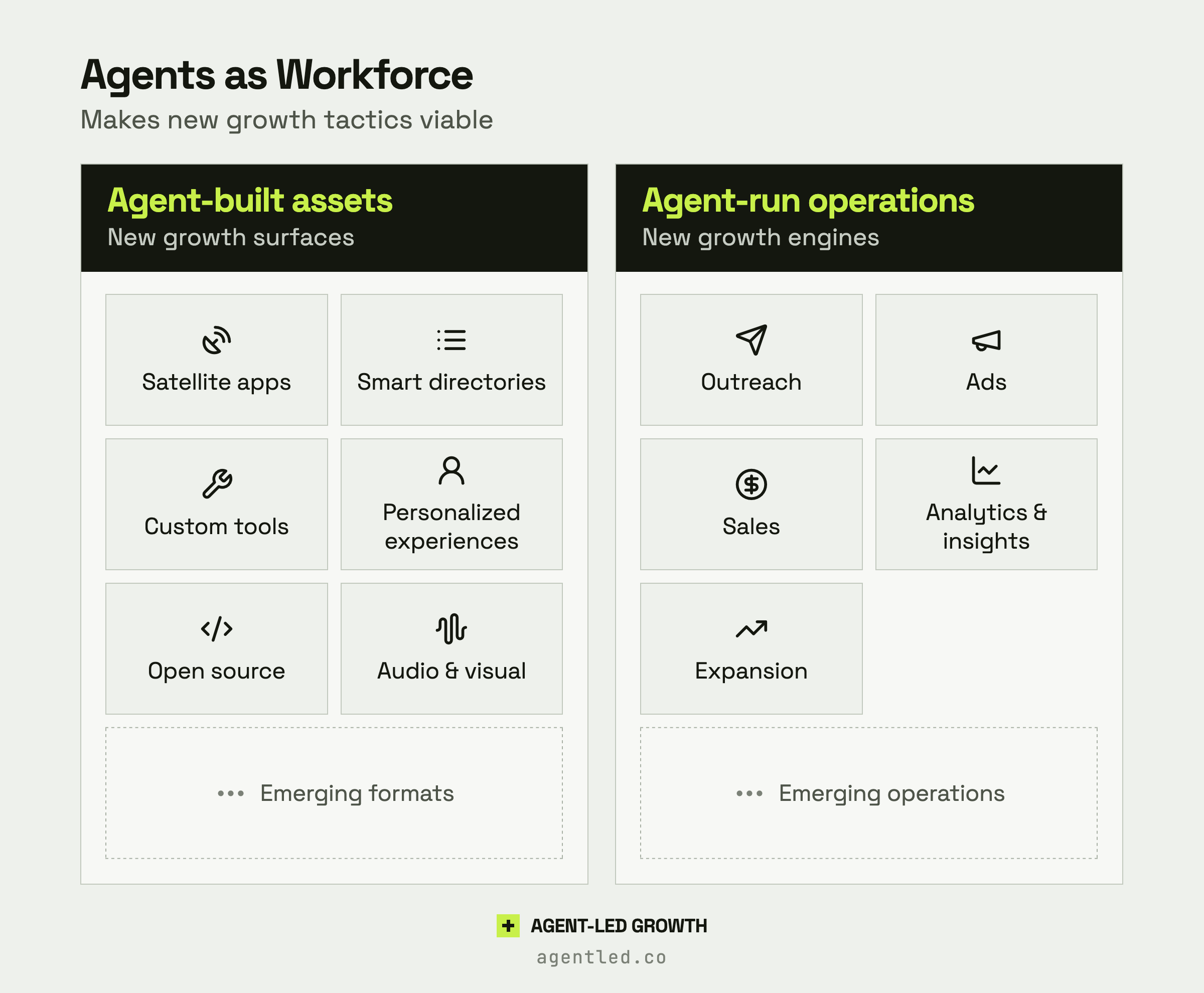
1. Agent-built Assets
These are growth assets agents made practical to build and maintain. Satellite apps5 (by Jonathan Yagel and Elena Verna) are one example. Instead of gating a PDF behind a form, you build a small working product that gives the visitor something useful with their own data.
Content plays a big role here. AI-generated video and UGC are already making content cheaper to produce and distribute at scale. The same research or idea can become articles, video, audio, visuals and interactive experiences, creating more surfaces for discovery.
Open source adds another growth surface. Code, templates, skills and reusable components can spread through repositories, forks and other products. Others can build on them and distribute them further.
Every.to is a strong example of a company applying this model. A media and software company, it creates content and software to reinforce each other. The apps grow the audience, the audience buys the bundle, and each new product increases the value of the same subscription.
These assets are not only for humans. Agents consume them too. Video, audio, visuals, open source and structured content can all become inputs for training, retrieval, recommendations and future agent interactions.
2. Agent-run Operations
Agent-run Operations are the growth processes you hand over, to different degrees of autonomy, to agents.
Outreach and sales are the clearest examples. Good outreach always meant researching the account, finding a real reason to contact someone and writing something specific. Agents can now keep that work running across the market, then carry it further by qualifying leads, following up, spotting expansion opportunities and keeping an eye on accounts that would otherwise get ignored.
Analytics become proactive, not passive. Instead of waiting for someone to open a dashboard, an agent can keep watching conversion, behavior and drop-off, then surface what changed and what is worth acting on.
There is one important distinction that might have already crossed your mind. Where is the boundary? Using agents for admin, support or internal productivity is useful, but it is not Agent-led Growth. At least not at its core. The operations that matter here are the ones directly tied to pipeline, revenue or decisions that change how you grow.
Measuring Agent-led Growth
A growth framework cannot stop at acquisition. It also has to measure retention, expansion and revenue.
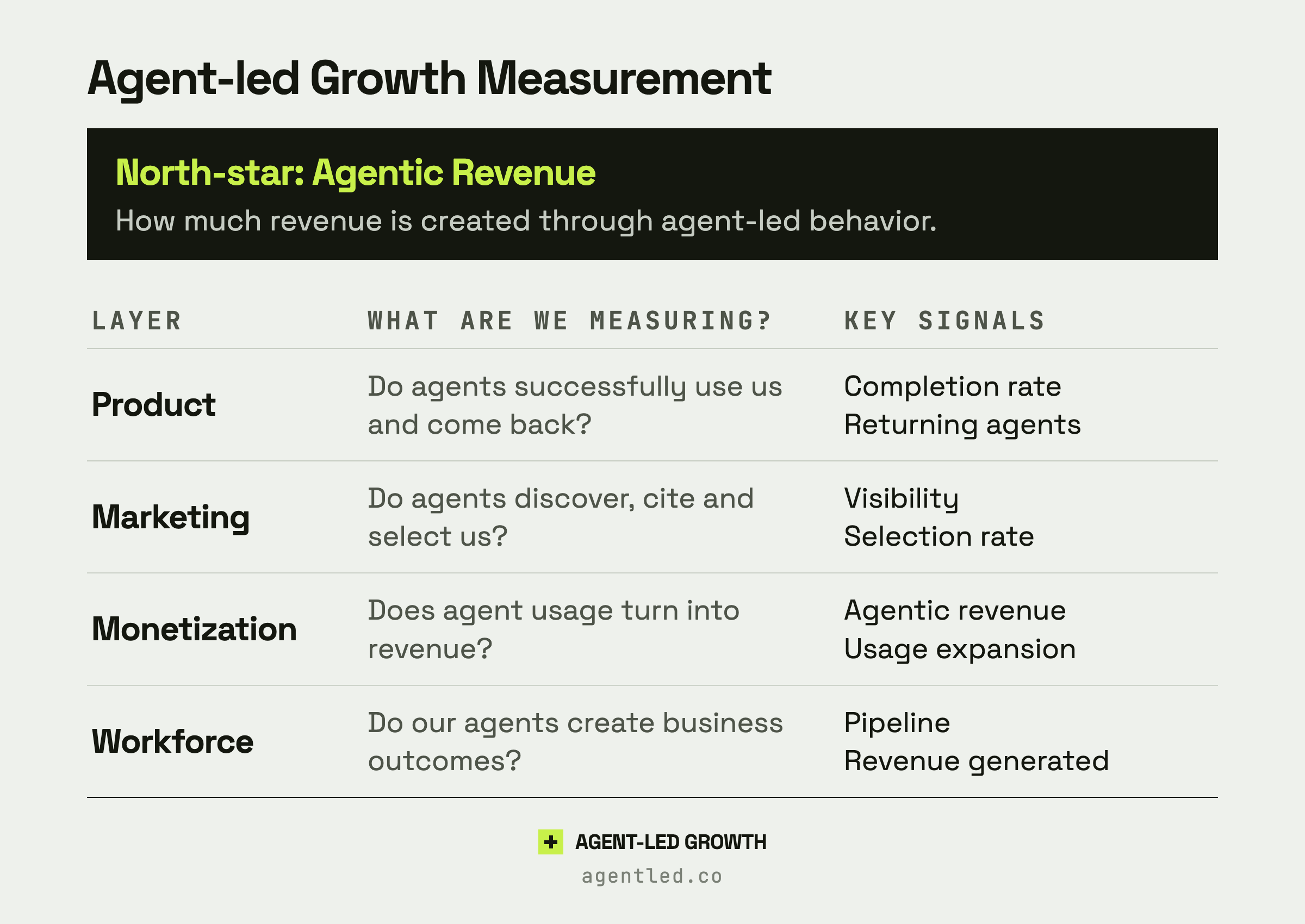
Product, Marketing, Monetization and Workforce are the measurement buckets.
Product
Measure whether agents can use you successfully and come back. Reliability is the retention strategy.
Successful completion rate
Agent share of actions
Returning agent rate
Agent churn
For open source: dependent repositories, forks and contributors. Stars are vanity, dependents are not
Marketing
Measure whether agents discover, cite and select you. Successful use can become repeat selection through defaults, examples and templates.
Visibility across assistants
Citation share against competitors
Selection rate
Monetization
Measure whether agent usage turns into revenue. Agentic revenue is measured as revenue from purchases initiated or decided by an agent and should be the north-star metric.
Agentic revenue
Revenue against the unit you price on, rather than seats
Expansion revenue from usage growth
Share of new revenue with no human touch before signup
It is still tricky to attribute because humans often complete the transaction. As agent identity and payments mature, more of that activity will become directly measurable. Start tracking it now so you have a baseline.
Workforce
Measure whether your own agents create business outcomes.
Conversion from agent-built assets
Pipeline and revenue from agent-run operations
Where Agent-led Growth Starts and Stops
To close this first iteration of the ALG framework, I think it’s important to set some boundaries and safeguards. AI and agents are being embedded into everything, with reason or by force, and I don’t want this to become another example of AI for the sake of AI. The core reason for this framework to exist is to drive growth in the new age of AI agents.
It is not only for software
Products, services, brands and people can all be designed to work better with agents. Software is where the mechanics are most mature today, but the expansion is already happening.
Using AI internally is not enough
Vibe coding, internal automation and productivity gains are useful, but they are not Agent-led Growth. The distinction is whether agents change how you get discovered, used, bought, or how growth work gets done. Measure growth, not productivity.
AEO is part of the framework, not the framework
Getting cited and recommended by AI assistants is the new gold rush. They way to get it is downstream of the product, marketing and monetization decisions that make you legible and useful to agents. It compounds.
Agent-led Growth is not a new channel. It is a change in how growth happens. The companies that adapt will build for agents, distribute through them, and use them to do growth work that was not viable before.
Bad Bot Report 2026: The Internet Is No Longer Human and It’s Changing How Business Works https://www.imperva.com/blog/bad-bot-report-2026-bots-agentic-age/
A New Direction for the Applied Report https://agentledco.substack.com/p/a-new-direction-for-the-applied-report
Agent-led growth: The next GTM motion is already here https://www.insightpartners.com/ideas/agent-led-growth/
Announcing Cloudflare Wallets: the programmable wallet for the agentic Internet https://blog.cloudflare.com/wallets/
Death to Lead Magnets! All Hail Satellite Apps. https://www.elenaverna.com/p/death-to-lead-magnets-all-hail-satellite
The token-to-value metric is the most useful concept in this framework. It is the machine equivalent of time-to-value, and it changes how you think about documentation. If an agent has to read three pages of prose to understand that your API accepts a JSON body with four fields, you have already lost the token budget and the agent moves on. The Supabase stat (60% of new databases created by AI coding tools) is the kind of concrete signal that makes this framework real, not theoretical. The pricing disruption point is worth expanding on. Per-seat pricing assumes headcount tracks usage. When an agent creates a database, provisions infrastructure, and deploys code without a human touching a keyboard, the seat becomes meaningless. Usage-based pricing is not just better fit, it is the only model that survives the transition.