

A New Direction for The Applied Report
What I learned from building Applied and why I’m focusing on Agent-led Growth

AI is changing how growth works.
Over the past three months, I’ve been building Applied and researching how companies adopt AI. I created agent-led systems to track real-world use cases, enterprise tools, vendors, and the latest open and closed models.
Applied now attracts thousands of visitors each month, and this publication passed 500 readers. Not bad for its first three months.
While trying to grow Applied, I saw firsthand how traditional discovery is changing.
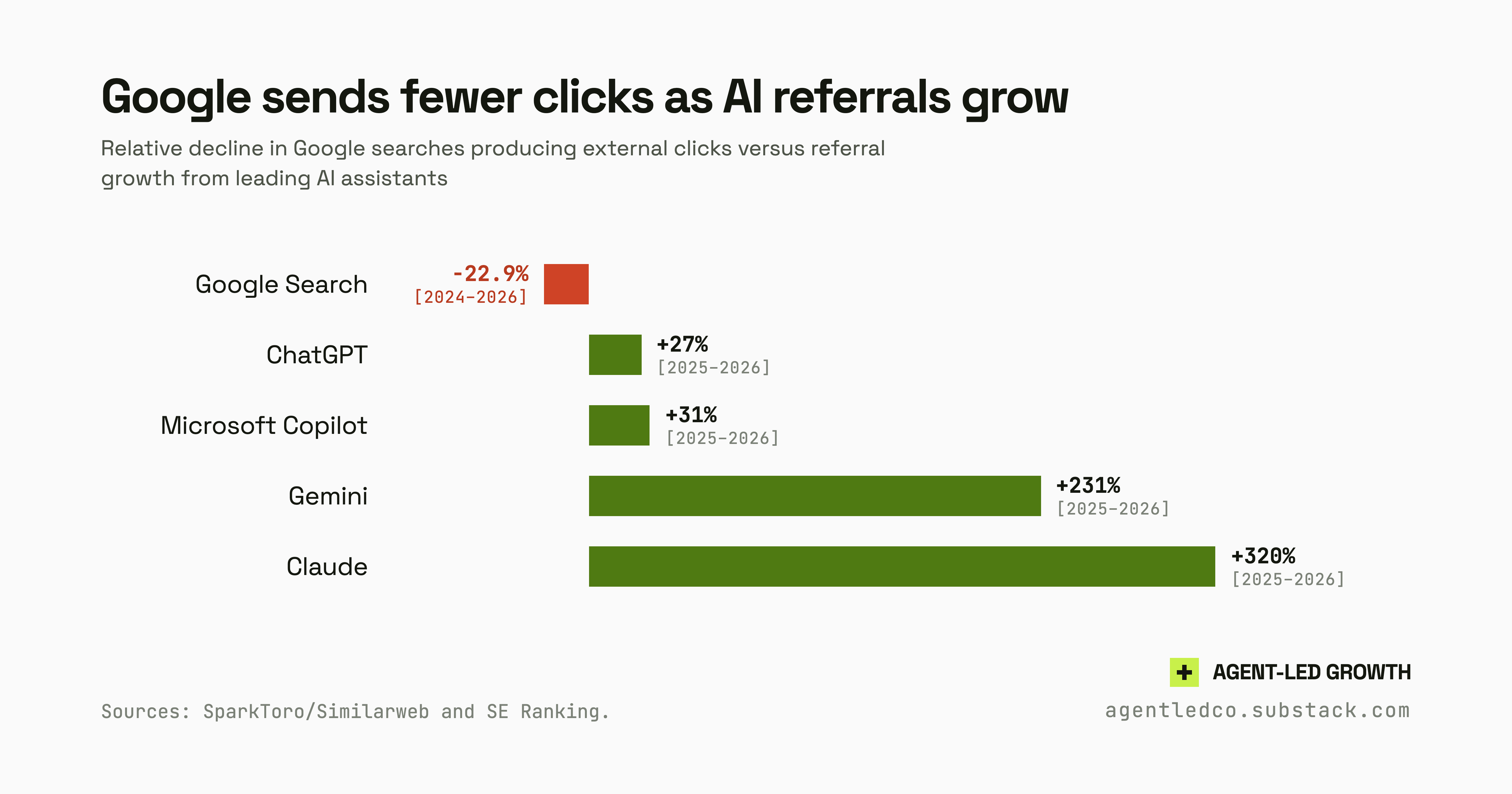
Search is one clear example. Google traffic is declining (-19.9% referrals since 2024), while referrals from ChatGPT, Claude, Gemini, and other AI platforms are surging. Discovery is increasingly happening through agents, rather than channels designed only for humans.
Some of the fastest-growing technology companies share a pattern of open-source and API-first design. This makes their products naturally compatible with AI agents. Supabase, for instance, recently shared that 60% of new databases on its platform are launched through some form of AI tool.
The core question I was exploring changed from:
How is AI being adopted?
To something more specific:
How do we grow in the age of AI?
Today, I’m refocusing this publication around that question. The Applied Report is becoming Agent-led Growth: Growth in the Age of AI.
Introducing Agent-led Growth
It’s no secret that agents have become part of how we research, build, operate, and make decisions. This is creating new interfaces, channels, and business models through LLMs, APIs, MCPs, skills, structured data, open source, and whatever comes next.
Agent-led Growth means designing discovery, distribution, and consumption around AI agents. In other words, building companies, products, services, and brands that agents can understand, recommend, and interact with.
What makes this exciting is that the field is still being defined. There is no established playbook, and the tools, channels, and strategies are evolving quickly. We have the chance to study what works, test new ideas, and learn as the category takes shape.
My goal is to connect the dots and turn what I learn into practical growth strategies.
Content pillars
The style will remain practical, now focused on Agent-led Growth. Some previous Applied articles already fit within its four pillars.
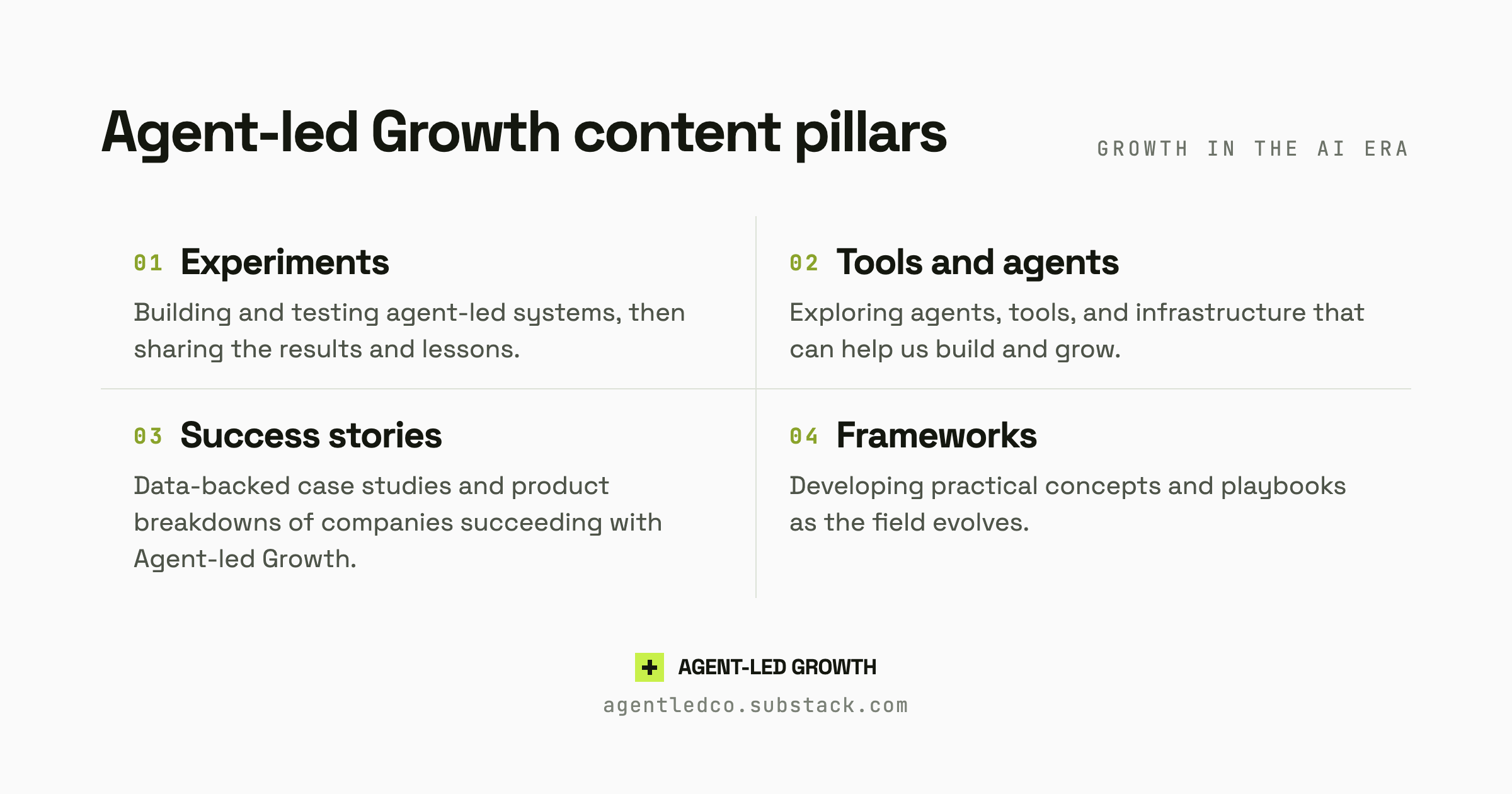
Experiments
Building and testing agent-led systems, then sharing the results and lessons.
👉 How I built a 6-agent research system
👉 How to observe and improve AI agents
Tools and agents
Exploring agents, tools, and infrastructure that can help us build and grow.
👉 How Headroom can reduce AI token costs by up to 90%
Success stories
Producing data-backed case studies and product breakdowns of companies succeeding with Agent-led Growth.
👉 How Supabase, Resend, n8n and PostHog grow
Frameworks
Developing practical concepts and playbooks as the field evolves.
Across these pillars, I plan to explore questions such as:
How can companies, products, and creators get discovered and recommended by ChatGPT, Claude, Gemini, and other AI systems?
How should we build products that agents can find, evaluate, and interact with?
What are the best practices for APIs, MCPs, skills, open source, and whatever comes next?
How can agents help us research, build, distribute, sell, and operate?
The goal is to make Agent-led Growth actionable.
Who is Agent-led Growth for?
If you have enjoyed the Applied content, you should find Agent-led Growth even more useful. It has a narrower focus built around one question: how do we grow in the age of AI?
It is for founders, product leaders, growth teams, marketers, and builders who want practical insights into how AI is changing discovery, distribution, and growth.

What remains from Applied
Applied is not disappearing. You can still explore the directory, use cases, tools, models, and adoption data here.
I’d love to hear what you think about the new direction. Leave a comment below or reply to this email.